Using annotation tools for collaboration

Requirements for screen annotation tools in virtual meetings

Note: The meeting host can disable participant annotation. If you do not have the annotation option, confirm that the host has not disabled annotation.

Table of Contents

How to use annotation tools for collaboration and brainstorming

Windows | macOS | Linux

Annotate if you are screen sharing

After sharing your screen or a classic whiteboard, annotation controls will display. If you don't see the annotation tools, click Annotate (if you are sharing your screen) or Whiteboard (if you are sharing a classic whiteboard).

Annotate if you are viewing shared content

While viewing a shared screen or shared classic whiteboard, click the pencil icon in the bottom-left corner.

Available annotation tools

You will see these annotation tools:

Note: The Select, Spotlight, and Save options are only available if you started the shared screen or a classic whiteboard.

  • Mouse: Deactivate annotation tools and switch to your mouse pointer. This button is blue if annotation tools are deactivated.
  • Select (only available if you started the shared screen or a classic whiteboard): Select, move, or resize your annotations. To select several annotations at once, click and drag your mouse to display a selection area.
  • Text: Insert text.
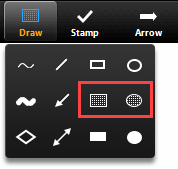
  • Draw: Insert lines, arrows, and shapes.
    Note: To highlight an area of the shared screen or the classic whiteboard, select the following square or circle icon to insert a semi-transparent square or circle.
  • Stamp: Insert predefined icons like a check mark or star.
  • Spotlight / Arrow: Turn your cursor into a spotlight or arrow.
    • Spotlight (only available if you started the shared screen or a classic whiteboard): Displays your mouse pointer to all participants when your mouse is within the area being shared. Use this to point out parts of the screen to other participants.
    • Arrow: Displays a small arrow instead of your mouse pointer. Click to insert an arrow that displays your name. Each subsequent click will remove the previous arrow placed. You can use this feature to point out your annotations to other participants.

  • Vanishing Pen (only available if you started the shared screen or a classic whiteboard): Allows the presenter to annotate on the classic whiteboard or shared screen without having to erase or undo their last addition, as the annotation will fade away within a couple of seconds.
  • Eraser: Click and drag to erase parts of your annotation.
  • Format: Change the formatting options of annotations tools like color, line width, and font.
  • Undo: Undo your latest annotation.
  • Redo: Redo your latest annotation that you undid.
  • Clear: Delete all annotations.
  • Save: Save shared screen / classic whiteboard and annotations as a PNG or PDF. The files are saved to the computer recording location.
    Note: This option is only available to viewers if the host has allowed others to save.
    • To change the file format, click the downward arrow next to Save and select one of these options:
      • PNG: Save as a PNG file. If there are multiple classic whiteboards, Zoom will save a PNG file for each classic whiteboard.
      • PDF: Save as a PDF. If there are multiple classic whiteboards, Zoom will save a single PDF containing all classic whiteboards.
  • More : Shows the option to dock the toolbar.

Annotation settings

If you started the shared screen or a classic whiteboard, click More  in the screen share controls for these annotation settings:

  • Enable/Disable Annotation for Others: Allow or prevent the participants from annotating on your shared screen.
  • Show/Hide Names of Annotators: Show or hide the participants' names when they are annotating.
    If set to show, the participant's name will briefly display beside their annotation.

Annotation shortcuts

Windows:

  • Undo: Ctrl + Z
  • Redo: Ctrl + Y
  • Mouse mode: Right-click anywhere

macOS:

  • Undo: Command + Z
  • Redo: Command + Shift + Z
  • Mouse mode: Right-click anywhere

Linux:

  • Mouse mode: Right-click anywhere


Android

Annotation tools for shared screen or classic whiteboard

  1. Start sharing your screen.
  2. Tap the pencil icon on your screen.
    This will open the annotation tools.
  3. Tap the pencil icon again to close the annotation tools.

The annotation tools available are dependent on whether you are using a phone or tablet.

Annotation tools specific to classic whiteboards

If you started sharing a classic whiteboard, you will see the following annotation tools:

Annotation settings

You can choose to allow participants to annotate on your shared screen and whether you want participants' names to appear next to their annotations.

  1. Tap the pencil icon to hide annotation tools.
  2. Tap More in the host controls.
  3. Tap Meeting Settings for these annotation settings under the Content Share section:
    • Annotate: Allow or prevent participants from annotating on your shared screen.
    • Show Names of Annotators: Show or hide the participants' names when they are annotating on a screen share.
      If set to show, the participant's name will briefly display beside their annotation.
     
iOS

Annotation tools for shared screen or classic whiteboards

Note: You cannot annotate when sharing your entire screen into the meeting via iOS device. You can only annotate when sharing a portion of your screen.

  1. Start sharing your screen.
  2. Tap the pencil icon on your screen.
    This will open the annotation tools.
  3. Tap the pencil icon again to close the annotation tools.

The annotation tools available are dependent on whether you are on an iPad or iPhone.

Annotation tools specific to classic whiteboards

If you started sharing a classic whiteboard, you will see the following annotation tools:

Annotation settings

You can choose to allow participants to annotate on your shared screen and whether you want participants' names to appear next to their annotations.

  1. Tap the pencil icon to hide annotation tools.
  2. Tap More  in the host controls.
  3. Tap Meeting Settings for these annotation settings under the Content Share section:
    • Annotate: Allow or prevent participants from annotating on your shared screen.
    • Show Names of Annotators: Show or hide the participants' names when they are annotating on a screen share.
      If set to show, the participant's name will briefly display beside their annotation.

Zoom’s in-meeting product features allow you to add annotations on your screen during your video calls — a tool for remote teams to easily brainstorm and collaborate. Both presenters and viewers can annotate during screen sharing. This tool is also available when sharing or viewing a classic whiteboard.